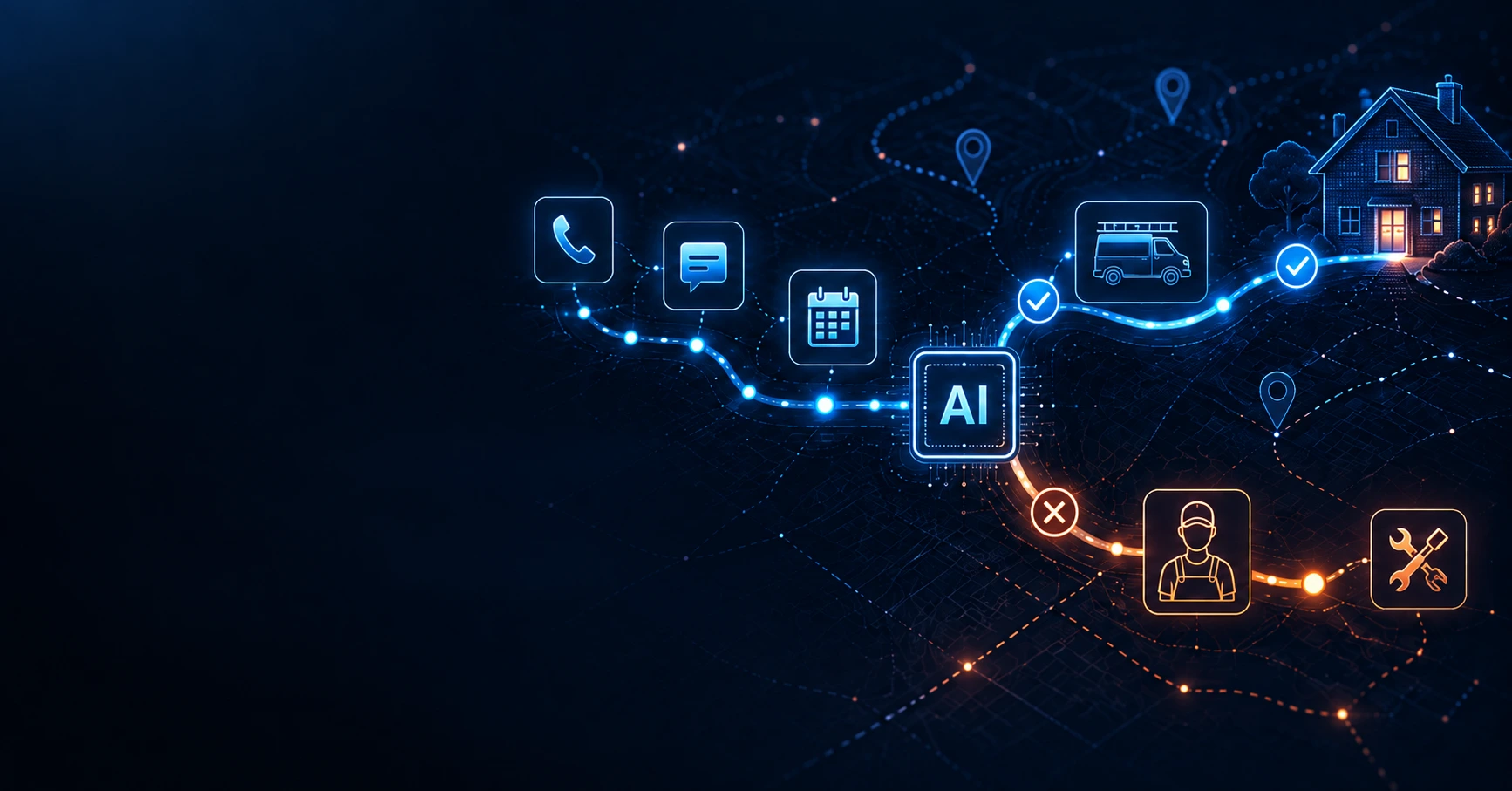
Some customer interactions are natural fits for AI: confirming an appointment, answering a routine question, sending a reminder.
Others get risky fast.
Think about a pricing dispute, a failed repair, or a homeowner calling because the heat is out and they are already frustrated.
The question is not simply whether AI can participate in customer service. It is where you should let it act on its own, where it should assist a person, and where a person should stay in control.
Recent consumer research gives us a useful way to start drawing that line. Across several industries, people appear much more comfortable with AI when the job is specific, low-risk, and easy to correct. Their comfort drops when judgment, money, emotion, or meaningful consequences enter the picture.
For a trades business, that creates a practical framework for deciding what to automate next.
What does an AI trust map look like for a trades business?
Think about your customer experience in two zones.
In the first, AI can take on work that is bounded, informational, and easy to correct.
In the second, a person should stay closely involved because the interaction requires judgment, empathy, negotiation, or a decision that is difficult to undo.
This does not mean AI belongs in one zone forever. It means you need a clear reason before moving it further.
Where are people comfortable with AI?
One useful signal comes from a September 2026 consumer survey from communications company Sinch. The survey asked 2,501 consumers across eight markets how comfortable they were using AI for different shopping-related tasks.
The answers changed quite a bit depending on what AI was being asked to do.
Eighty-one percent said they were confident an AI assistant could handle order tracking and shipping updates. Seventy-four percent said the same about pre-purchase questions.
When the task became more sensitive, confidence fell. Sixty-six percent were confident using AI for account changes, and 62 percent said the same for payment or billing changes.
Retail shopping is not the same as booking an HVAC repair or calling a plumber. But the pattern is useful: people appear more comfortable handing AI a defined task than handing it judgment.
For a trades business, that points to tasks like:
- Appointment scheduling and rescheduling
- Reminders and confirmations
- "Your technician is on the way" updates
- Routine questions about hours or service areas
- After-hours intake
- Basic lead qualification
- First drafts of estimate follow-ups
These are jobs where the system can be given clear boundaries, the information can be verified, and mistakes can usually be caught and corrected.
What happens when the stakes go up?
Another recent survey looked at an industry where trust and financial consequences play a much larger role: insurance.
A September 2026 national survey commissioned by the Independent Insurance Agents and Brokers of America found that 61 percent of consumers were more likely to choose an insurance agent who uses AI and modern technology.
At the same time, 87 percent still said having a human insurance agent was important.
That gap became even clearer when consumers were asked about major events such as accidents, storms, or significant claims. Just 6 percent said they would rely on AI alone.
In other words, people can be comfortable with a business using AI without wanting AI to make every decision.
Research from Rutgers University reinforces that distinction.
In September 2026, Rutgers released findings from its National AI Opinion Monitor examining how Americans are using AI and how much decision-making authority they are willing to give it.
Seventy-two percent of U.S. adults had used at least one major AI tool. But fewer than one in ten said AI should be allowed to make the final decision without human supervision in areas such as hiring, loans, college admissions, parole, or medical priority.
Researcher Katherine Ognyanova summed up the distinction clearly:
"Using a tool and trusting it fully are two different things."
That matters for contractors.
A customer may be perfectly comfortable using AI to move an appointment from Tuesday to Wednesday.
That does not mean they want the same system handling a complaint about a failed repair.
For a trades business, the human zone likely includes:
- Complaints and service recovery
- Bad-news calls involving delays or price changes
- Distressed customers dealing with no heat, no AC, flooding, or another urgent problem
- Large-ticket estimates that require explanation or negotiation
- Exceptions to company policy
- Situations where the customer's intent is unclear
- Decisions that are difficult to reverse
AI can still support the employee handling these situations. It can surface account history, summarize previous conversations, suggest responses, or prepare information.
But supporting the decision is different from owning it.
A simple way to draw the line
Use this question on every customer touchpoint:
If the AI gets this wrong, how difficult is the mistake to recover from?
A scheduling error may frustrate someone, but it can usually be corrected quickly.
Giving a distressed homeowner the wrong information, mishandling a complaint, or making an unauthorized pricing decision could create a much bigger trust problem.
That gives you a simple framework:
| Good starting points for AI | Keep a person closely involved |
|---|---|
| Appointment scheduling | Complaints and service recovery |
| Reminders and confirmations | Bad-news calls |
| Technician tracking | Distressed or emotional customers |
| Routine FAQs | Large-ticket estimate discussions |
| After-hours intake | Policy exceptions |
| Basic lead qualification | High-impact or difficult-to-reverse decisions |
| Follow-up drafts | Situations requiring judgment |
The goal is not to find every task AI can perform.
It is to decide which tasks it should own.
How do you apply the map this week?
Start with your ten most common customer interactions.
That might include:
First phone call.
Website inquiry.
Appointment booking.
Confirmation.
Dispatch update.
Estimate.
Estimate follow-up.
Invoice question.
Complaint.
Review request.
Then look at each one and ask:
Is this task structured enough for AI to handle reliably?
What happens if it gets something wrong?
When should a person take over?
Once you find one clearly bounded task, automate that first.
Then define the handoff before you turn anything on.
What should the AI say when it reaches its limit?
Who gets the conversation?
How quickly should that person respond?
What information should transfer with the customer so they do not have to start over?
The automation is only as good as the handoff when something falls outside the script.
Let trust expand based on evidence
Your AI trust map does not have to stay the same forever.
Start with tasks where the boundaries are obvious. Measure what happens. Look at booking accuracy, customer responses, handoff rates, missed calls, complaints, and exceptions.
Then decide whether AI has earned more responsibility.
A practical progression might look like this:
Stage 1: Automate straightforward tasks such as scheduling, reminders, tracking, and routine questions.
Stage 2: Add more complex workflows such as after-hours intake or lead qualification, with a clearly defined human handoff.
Stage 3: Review the results with your team and identify where another task has become structured enough to automate safely.
Some interactions may never move completely into the AI zone.
That is fine.
The point is not maximum automation. It is putting AI where it makes the customer experience faster and easier while keeping people where human judgment adds the most value.
What to do next
Take your ten most common customer touchpoints and sort them into two groups:
AI can own this.
A person should stay involved.
Then choose one task from the first group and define the human handoff before you automate it.
If you want help figuring out where your business is ready to use AI next, take the Just Start AI assessment or work through the Automate Your Front Office learning path.
Start with one clearly defined job. Measure what happens. Then decide what AI earns the right to handle next.

About the author
Jennifer Bagley
Jennifer Bagley is a co-founder of JustStart AI, founder and CEO of CI Web Group, and the author of Hands Up. Her work focuses on practical AI use in HVAC, plumbing, and electrical businesses.
Visit JenniferBagley.comRelated Articles
Continue exploring similar topics and insights
How Trades Companies Are Using AI in 2026: The Field Report
AI receptionists at 15-20% adoption, agentic back offices, AI-powered websites that book jobs inside ChatGPT — here's where AI in the trades actually stands in mid-2026.
AI for HVAC Contractors: Increase Revenue & Customer Satisfaction (2025)
Learn how HVAC contractors use AI for scheduling, diagnostics, and customer service. Real case studies show 28% productivity gains and 31% customer retention improvement.
AI for Plumbing Contractors: Boost Response Time & Revenue (2025)
Discover how plumbing contractors use AI for emergency dispatch, customer service, and lead generation. Case studies show 52% faster emergency response and 31% revenue growth.
More in Trades Adoption
Explore more articles in this category
How Trades Companies Are Using AI in 2026: The Field Report
AI receptionists at 15-20% adoption, agentic back offices, AI-powered websites that book jobs inside ChatGPT — here's where AI in the trades actually stands in mid-2026.
AI for HVAC Contractors: Increase Revenue & Customer Satisfaction (2025)
Learn how HVAC contractors use AI for scheduling, diagnostics, and customer service. Real case studies show 28% productivity gains and 31% customer retention improvement.
AI for Plumbing Contractors: Boost Response Time & Revenue (2025)
Discover how plumbing contractors use AI for emergency dispatch, customer service, and lead generation. Case studies show 52% faster emergency response and 31% revenue growth.
Questions, results, or pushback — the conversation lives in the JustStart AI community. It's free to join.