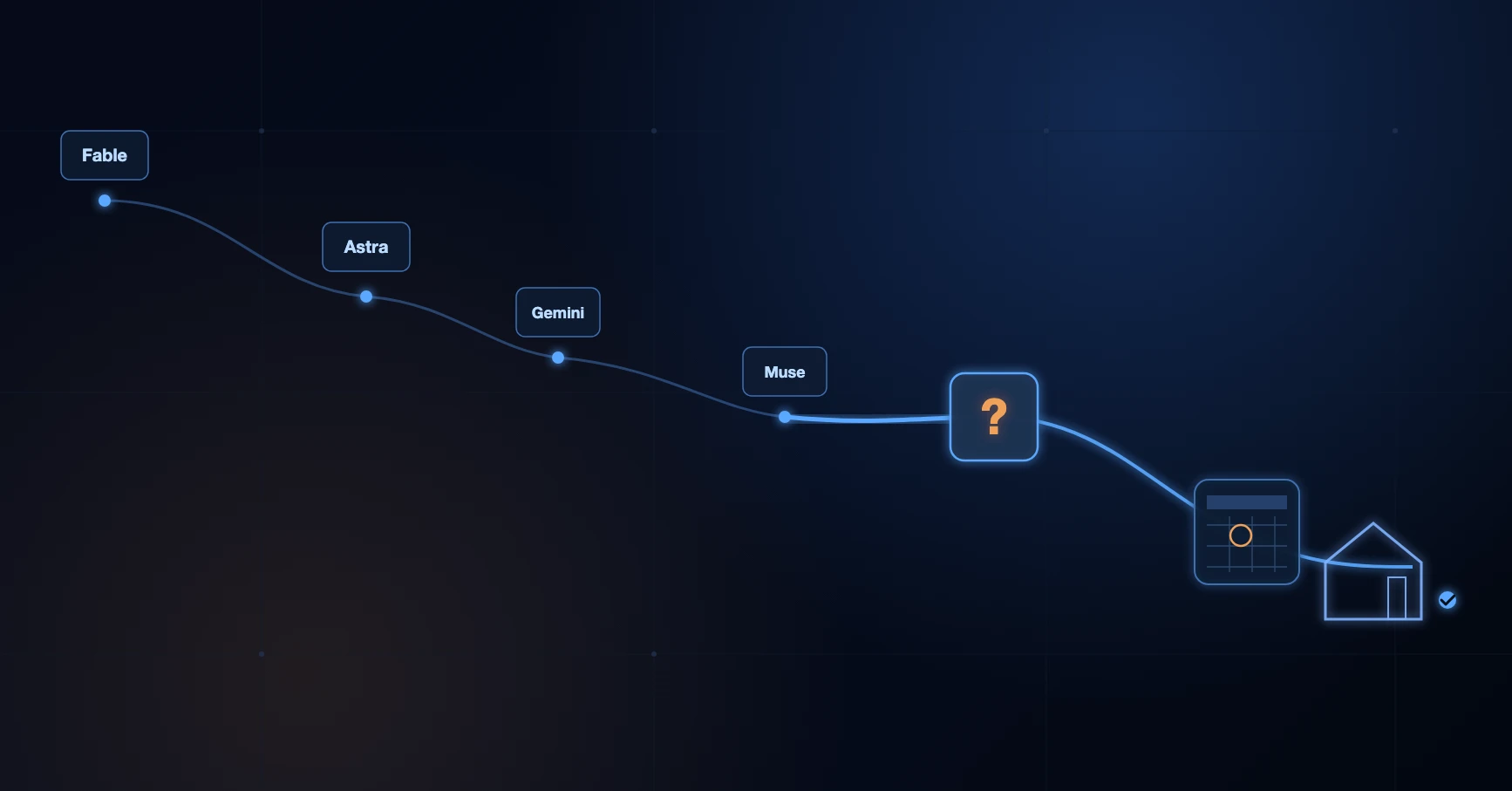
Four AI labs shipped new models in the first week of September 2026, and CNBC called the result model fatigue. You do not need to track every launch. You need one question that tells you whether a new model deserves a minute of your attention, and the rest can wait until your tools upgrade themselves.
What is AI model fatigue?
It is the feeling of falling behind on something you were never required to follow. In the first week of September, Anthropic released Claude Fable 5.1 and Mythos 5.1, Meta released Muse Spark 1.3, Google moved with Gemini 3.8 Flash, and OpenAI followed with GPT-6 Astra, which OpenAI described as its most capable system yet. Four labs, one week, each claiming a new frontier. Reporting on the pileup, CNBC said model fatigue is real.
Fatigue is a useful signal. It tells you the release cadence is now faster than any normal business can evaluate. The labs are not shipping for you. A Notre Dame professor told CNBC the fight is for "share of wallet": every lab is trying to be the one your company pays. That is their calendar, not yours.
Why do new models ship faster than you can evaluate them?
Because the business model rewards shipping. When OpenAI launched Astra on September 3, it went first to cybersecurity customers in the Daybreak program, then out to paid plans and the API within about a week. Speed of rollout is the product strategy: be the default assistant in the most offices, win the most developer loyalty, keep the benchmark crown between releases.
Notice what actually moved the needle in that same reporting. Reuters reported that OpenAI cut prices by 80 percent on one of its cheaper models and usage rose tenfold. The capability leap made the headlines. The price cut changed behavior. For a contractor, that is the pattern to watch: launches get the coverage, but the economics quietly decide what shows up in the tools you already pay for.
That same week showed where the money goes inside the labs. Some of OpenAI's heaviest internal Astra users burn about $7,000 worth of tokens a day, roughly $1.5 million a year. Your shop will never spend like that, and it should not try. You get the benefit when those token dollars turn into cheaper, more reliable inference inside the software you already use.
Model headlines, translated for your shop
| What the headline says | What it means for your shop |
|---|---|
| "Most capable model yet" | A benchmark moved. Nobody booked a job from a benchmark. |
| "New model available via API" | Vendors can upgrade under the hood. Ask your vendors, not your team. |
| "80% price cut" | The same work gets cheaper. Re-check what automation costs this quarter. |
| "Best model for agentic work" | Long multi-step tasks get more reliable. Retry the office task that failed last quarter. |
| "Released to paid plans this week" | Your subscriptions improve on their own. You do not need to do anything. |
The pattern is consistent: almost nothing in a launch announcement is addressed to a contractor. It is addressed to developers, investors, and journalists. Your action happens one layer down, where your vendors decide what to adopt.
The Last-Monday Test: the one question for every new model
Here is the single reusable question. Keep it on a sticky note:
If we had this model last Monday, which specific job would have gone differently, and for whom?
If you can name the job and the person, the model deserves your attention. If you cannot, the launch is noise for now, and ignoring it is a sound business decision, not a gap in your education.
Run the test in five minutes the next time a launch headline crosses your feed:
- Pick one real job from last week. The appointment that got confirmed late. The price the customer disputed. The no-heat call your dispatcher triaged at midnight.
- Say what went wrong on that job, in one sentence. The wrong part number on the truck. The follow-up that never went out. The photo that never reached the technician.
- Ask whether a smarter model would have changed that sentence. Not "a smarter assistant in general," the specific failure. If the answer is no, you have learned everything the launch has to teach you.
The test works because it forces the launch through your calendar instead of the lab's marketing. A contractor's week is a hard exam. "Better reasoning" is not a job. "The dispatcher stops re-typing call notes" is a job.
Two traps to watch. First, the test fails upward: if you cannot name the job, do not buy the model, buy the question. Go find the failure it would have fixed. Second, the test expires: run it again when your vendor says they upgraded. The right answer changes as your tools absorb new models quietly, which is how most of this technology will actually reach your shop.
What actually changes for your shop (it is not the model name)
Three things change, and none of them require you to learn a new model name:
The tools you already pay for get better on their own. AI CSRs, marketing engines, CRMs, and back-office copilots often run on a model you never chose. When a cheaper, stronger model arrives, the vendor can raise quality without raising your bill. The question to ask is vendor-shaped, not model-shaped: "Which model powers your product, and when did you last upgrade?"
The same work gets cheaper, so re-price your automation. An 80 percent price cut that drives a tenfold usage jump tells you exactly where AI economics are heading. Whatever you priced an AI workflow at last year, re-price it this quarter. Tasks that were too expensive to automate in 2025 are cheap experiments in 2026.
Workflows matter more than models. The 2026 LLM guide for contractors lands in the same place quarter after quarter: for everyday office tasks, all of the leading models are good enough, and what matters is product, price, and what your team will actually use. Build habits and workflows, not brand loyalty. Our Claude Opus 5 breakdown makes the same point from the vendor side: the win is better tooling at everyday prices, not a new name to memorize.
The order of operations is: test first, compare second, buy never in a hurry.
What to do next
This week, do one thing. Open the tool you already use most, a CSR platform, your CRM, your review tool, and send your vendor one email: "Which AI model is powering this right now, and what changed in the last upgrade?" Their answer tells you whether they are riding the price cuts or coasting. Then take the AI-Q assessment to find which task in your operation deserves AI first, run the Last-Monday Test on it, and follow the AI adoption roadmap for the sequence. You will know exactly where a new model would matter, and exactly which launches you can safely ignore. More explainers live on the JustStart AI blog, the Knowledge Hub.
Data accurate as of September 2026.

About the author
Jennifer Bagley
Jennifer Bagley is a co-founder of JustStart AI, founder and CEO of CI Web Group, and the author of Hands Up. Her work focuses on practical AI use in HVAC, plumbing, and electrical businesses.
Visit JenniferBagley.comRelated Articles
Continue exploring similar topics and insights
"AI Copilots Could Fix What SFA Got Wrong": JustStart AI in DestinationCRM
DestinationCRM featured JustStart AI founder Jennifer Bagley on why AI copilots succeed where traditional sales force automation fell short — by starting with where humans are re-keying, delaying, or dropping the ball.
Claude Opus 5 Is Close to Fable — at Half the Price. Here's What Matters for Trades
Anthropic launched Claude Opus 5 on July 24, 2026 — near Claude Fable 5 intelligence at half the cost. What that means for contractors who use AI every day.
GPT-5.6 Is Here: What the Latest ChatGPT Updates Mean for Your Business
OpenAI launched the GPT-5.6 family (Sol, Terra, Luna) on July 9, 2026, plus a new Ultra mode and ChatGPT Work. Here's what actually matters for trades companies.
More in AI News & Launches
Explore more articles in this category
"AI Copilots Could Fix What SFA Got Wrong": JustStart AI in DestinationCRM
DestinationCRM featured JustStart AI founder Jennifer Bagley on why AI copilots succeed where traditional sales force automation fell short — by starting with where humans are re-keying, delaying, or dropping the ball.
Claude Opus 5 Is Close to Fable — at Half the Price. Here's What Matters for Trades
Anthropic launched Claude Opus 5 on July 24, 2026 — near Claude Fable 5 intelligence at half the cost. What that means for contractors who use AI every day.
GPT-5.6 Is Here: What the Latest ChatGPT Updates Mean for Your Business
OpenAI launched the GPT-5.6 family (Sol, Terra, Luna) on July 9, 2026, plus a new Ultra mode and ChatGPT Work. Here's what actually matters for trades companies.
Questions, results, or pushback — the conversation lives in the JustStart AI community. It's free to join.