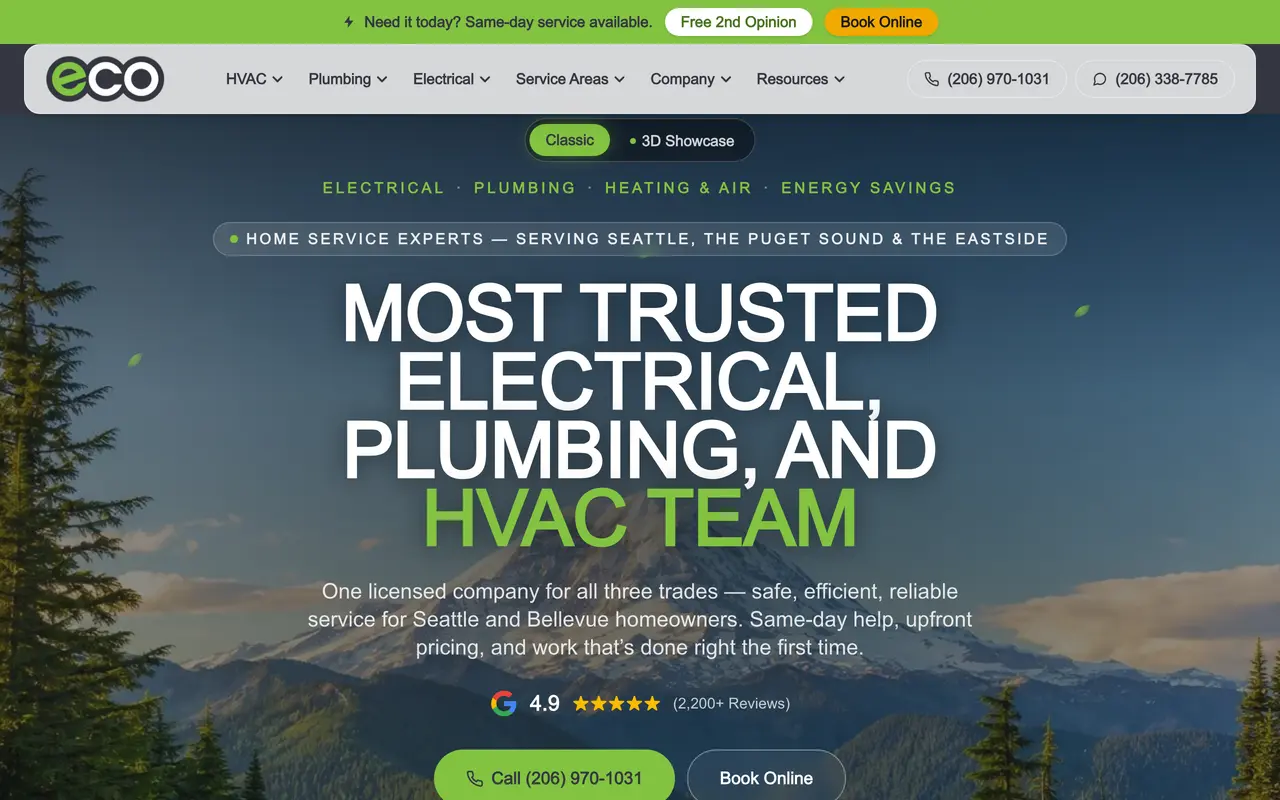
The short version: Eco Electric, Plumbing, Heating And Air (ecoserviceswa.com) is a family-owned, tri-trade home services company — electrical, plumbing, and HVAC — serving Seattle and the Puget Sound since 2012, with a 4.9-star rating across 2,200+ Google reviews. In June 2026 they relaunched on Hydra OS, and the architecture is the interesting part: one heavyweight main site built for organic and AI search, plus a mesh of 36 city-and-trade microsites for paid traffic. In the first week live, clicks on their brand search jumped 63%, with brand click-through rate rising from 13.2% to 21.1%.
Disclosure: Eco Electric, Plumbing, Heating & Air is a CI Web Group client, and JustStart AI is a CI Web Group company. Per our editorial standards, performance figures below are percentage deltas and measured page scores from the client's published spotlight — sources labeled throughout.
The company
Owner Cory Hesseltine's operation is unusual in one important way: it runs three licensed trades under one roof (WA Lic. #ECOELEP765P5) — electrical, plumbing, and heating and air — across 24 Puget Sound cities from a Seattle headquarters, spanning residential service, new construction, and light commercial. The trust file was already deep: BBB A+, Google Guaranteed, Best Pick Reports, a "People Love Us on Yelp" award, manufacturer authorizations from Daikin, QuietCool, Infratech, and Navien, and that 4.9-star, 2,200+ review base — all run on ServiceTitan.
The problem was the familiar one: a WordPress site that lost ground after a Google update, thin map-pack visibility for a company this size, and paid traffic filling the gap that organic should have owned.
The architecture: one flagship, 36 satellites
Most contractor "SEO projects" are one website. Eco's rebuild is a system with two deliberately different halves:
The flagship (ecoserviceswa.com). A full Hydra OS build tuned for organic, answer-engine, and AI search: a learning center with roughly 50 guides, energy-savings and financing calculators, a rebates explorer, a "what's going on at your place?" issue selector, brand and product catalogs, a glossary, a referral program, a reviews engine, and a free-second-opinion funnel. The build rules in the project brief are telling: Core Web Vitals with sub-3-second mobile loads, E-E-A-T signals throughout, and no stock photography — owned imagery only. Launch measurements: Lighthouse 99 performance on desktop (0.7s largest contentful paint, zero layout shift) and a 100 performance score on the mobile re-measure in early July.
The mesh (36 microsites). Alongside the flagship: dedicated microsites for every city-and-trade combination that matters to the business — seattle.hvac.ecoserviceswa.com, tacoma.plumbing.ecoserviceswa.com, and 34 more covering eight full three-trade markets (Seattle, Bellevue, Everett, Kent, Tacoma, and King, Pierce, and Snohomish counties) plus nine plumbing-focused North Sound cities and three trade hubs. Each carries its own call-tracking phone number and is deliberately kept out of Google's organic index — these exist to make paid clicks convert, not to compete with the flagship. A visitor from a Tacoma plumbing ad lands on a Tacoma plumbing page with a Tacoma tracking number, not a generic homepage.
That separation — organic authority concentrated in one flagship, paid traffic landing on purpose-built satellites with clean attribution — is the pattern worth copying, and it's the kind of thing that's only practical when sites are generated from a platform rather than hand-built one at a time. (Our components tour explains the catalog approach behind builds like this.)
What happened at launch
The first-week measurement, per the published spotlight (percentages only, per the data-handling rules): searches for the company's own brand converted to clicks at 21.1%, up from 13.2% in the pre-launch baseline — a 63% jump in brand clicks week over week. Same caveat we applied in the AirWorks spotlight: brand CTR is a leading indicator. The organic flywheel — the learning center, the city pages, the AI-search citations — compounds over months, and we'll report those numbers when they're measured rather than projected.
The owner's reaction was less measured. Cory Hesseltine's on-the-record pull quote is, verbatim, "I freaking love it." General manager Christine Sin left a verified five-star Google review of the project in July. And in a detail that says something about 2026: an independent AI audit of the new site a week after launch described it as a blueprint-quality build — third-party AI commentary, but a reminder that AI systems are now evaluating contractor websites, not just ranking them.
What other contractors can copy
- Split organic and paid at the architecture level. One authoritative site earns rankings and AI citations; separate landing microsites make ads convert and keep attribution clean. Mixing the two jobs on one site does both badly.
- Tri-trade companies: build for the combination. Eco's mesh covers every city × trade cell independently, so a Bellevue electrical searcher and an Everett plumbing searcher each get exactly their page. Multi-trade shops that funnel everything to one homepage leave this on the table.
- Give every visitor a calculator, not just a phone number. Energy savings, financing, rebates, second opinions — Eco's flagship converts anxious researchers the way AirWorks' tools do in SoCal.
- Treat measurement rules as part of the project. Eco's spotlight publishes percentage deltas and page scores, and keeps raw click and lead counts internal. Decide your own publishable-metrics policy before you start, and baseline everything.
- Own your imagery. No stock photos was a build rule, not a preference — real trucks and real techs are an E-E-A-T signal both homeowners and AI engines reward.
The bottom line
Eco Electric, Plumbing, Heating & Air shows what the AI-era playbook looks like at multi-trade scale: 37 coordinated sites, conversion tooling everywhere a homeowner hesitates, and a measurable brand-visibility jump inside the first week. The pattern is the point — organic authority and paid conversion are different machines, and the companies pulling ahead in 2026 are building both on purpose.
See the flagship at ecoserviceswa.com, explore the platform behind it at /ci-web-group, or take the AI assessment to find out whether your next dollar belongs in organic authority or paid conversion.
Sources: CI Web Group featured-customer spotlight and launch measurement data (June–July 2026); metrics published as percentage deltas per the spotlight's data-handling rules.

About the author
Jennifer Bagley
Jennifer Bagley is a co-founder of JustStart AI, founder and CEO of CI Web Group, and the author of Hands Up. Her work focuses on practical AI use in HVAC, plumbing, and electrical businesses.
Visit JenniferBagley.comRelated Articles
Continue exploring similar topics and insights
Customer Spotlight: Advanced Air's Escape From the $10K-a-Month Ad Treadmill
A Cedar Park HVAC company was spending $10K+ a month competing with PE-backed ad budgets. They rebuilt on Hydra OS — delivered two months early — and changed the game.
Customer Spotlight: Cherry Blossom Plumbing's 35X ROAS and the AI-Native Rebuild
A five-year-old DMV plumbing company reports 35X return on ad spend against a 10X benchmark — and its next website is being built for AI readers from day one.
Customer Spotlight: Door Serv Pro's Four-State Garage Door Machine
A family-owned garage door company spanning WV, MD, VA, and PA rebuilt on Hydra OS — and booked appointments rose 26% in the first ten days. Inside the build.
More in Sponsor Spotlight
Explore more articles in this category
Customer Spotlight: Advanced Air's Escape From the $10K-a-Month Ad Treadmill
A Cedar Park HVAC company was spending $10K+ a month competing with PE-backed ad budgets. They rebuilt on Hydra OS — delivered two months early — and changed the game.
Customer Spotlight: Cherry Blossom Plumbing's 35X ROAS and the AI-Native Rebuild
A five-year-old DMV plumbing company reports 35X return on ad spend against a 10X benchmark — and its next website is being built for AI readers from day one.
Customer Spotlight: Door Serv Pro's Four-State Garage Door Machine
A family-owned garage door company spanning WV, MD, VA, and PA rebuilt on Hydra OS — and booked appointments rose 26% in the first ten days. Inside the build.
Questions, results, or pushback — the conversation lives in the JustStart AI community. It's free to join.